

Selling an accountancy practice is rarely the simple transaction owners expect it to be. Recurring fees, client retention, professional body requirements, and run-off insurance all affect what the deal looks like and what you actually walk away with. This guide covers what to think about before you commit, how practices are valued, what the process looks like, and where the regulatory complexity sits.
Should I Sell My Accountancy Practice
Selling is a permanent decision. Before you commit, be clear about why you are doing it. Retirement, capital release, exit from a sector that is changing faster than you want to keep up with, or a genuine desire to step back. Each motivation produces a different deal structure.
If the answer is retirement, you will want to maximise upfront consideration and minimise any stay-on requirement. If you are open to remaining involved, you may achieve a higher headline price through earn-out arrangements or a phased handover. Buyers will ask about your motivation early. Your answer affects how they structure their offer and what they expect from you post-completion.
How Much Is Your Accountancy Practice Worth
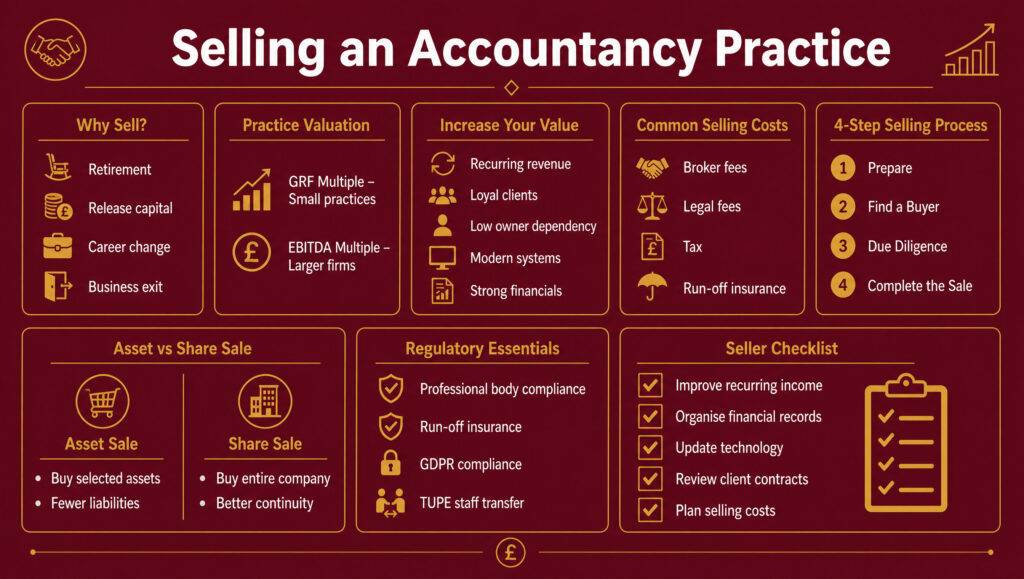
UK accountancy practices are typically valued by one of two methods. Smaller and mid-sized practices are valued on a multiple of Gross Recurring Fees, the annual income from ongoing predictable services. Larger or more profitable practices are valued on an EBITDA multiple.
The GRF method is more common for owner-operated practices. The EBITDA approach tends to deliver a higher figure for practices with strong margins, low owner dependency, and a structured management team.
What moves the multiple up:
- Recurring revenue locked in through monthly direct debit
- Low owner dependency, with a team that can deliver client work without you
- Diverse client base with no single client representing a disproportionate share
- Strong client retention history
- Cloud-based systems and modern technology
- A specialist niche that commands premium pricing
- Clean three-year financial records
What moves it down:
- High concentration of one-off advisory work versus recurring compliance
- Owner-dependent client relationships
- Paper-based or outdated technology
- Inconsistent margins
- Client concentration risk
What It Costs to Sell an Accountancy Practice
The headline sale price is not what lands in your account. Several cost categories sit between gross proceeds and net.
- Broker commission: Most accountancy practice sales go through a specialist broker. Commission is typically paid by the seller and varies with the size and complexity of the deal
- Legal fees: Your solicitor’s costs for due diligence, contract negotiation, and completion
- Accountant fees: Your own accountant’s role in preparing the financials and advising on tax structuring
- Run-off insurance: Required by professional bodies for a period after the sale, with the first year typically at the normal rate and subsequent years tapering down
- Tax: Capital gains tax on the sale proceeds, mitigated where applicable by Business Asset Disposal Relief under the Taxation of Chargeable Gains Act 1992
Plan for all of these before agreeing a sale price. The cost of selling does not move proportionally with the sale figure, and underestimating it is one of the most common mistakes sellers make.
The Step-by-Step Process
Preparing to Sell
Preparation starts 2 to 3 years before the planned sale. The goal is to make the practice as attractive as possible to the broadest pool of buyers. That means reducing owner dependency, building recurring fee income, migrating clients to direct debit, modernising the tech stack, and producing three years of clean financial records.
Practices that go to market without this preparation typically achieve lower multiples and slower sales. The work you do before listing is the highest-return work in the entire process.
Going to Market
Engage a specialist accountancy practice broker. Generalist business brokers do not understand the valuation drivers and buyer pool well enough to price or position the practice correctly. Your broker will produce a marketing document, manage confidentiality, and present the practice to a curated list of qualified buyers under non-disclosure agreement.
Most sellers do not announce the sale to staff at this stage. Confidentiality matters. A leak can affect client retention and staff stability long before you have a buyer in place.
Due Diligence
Once an offer is accepted, the buyer’s solicitor and accountant conduct due diligence on the practice. This covers financial performance, client contracts and fee structures, staff arrangements, professional indemnity history, regulatory standing, IT systems, and any outstanding litigation or disputes.
Most due diligence issues that derail accountancy practice sales are issues the seller could have identified and resolved before listing. Buyers will ask about client engagement letters, complaint history, and disciplinary matters with the professional body. Having clean answers ready is significantly better than discovering problems at the same time as the buyer.
Completion
Completion involves the signing of the sale and purchase agreement, the release of consideration, and the transfer of client relationships and staff to the new owner. Most accountancy practice sales include a handover period during which the seller remains involved to transition client relationships smoothly.
Your solicitor manages the legal completion. Your broker manages the commercial handover. Both need to be in place before completion day, not arranged at the last minute.
Asset Sale vs Share Sale
In an asset sale, the buyer purchases specific assets of the practice: the client list, goodwill, equipment, and ongoing engagement letters. The legal entity stays with the seller. In a share sale, the buyer purchases the shares of the company that owns the practice and takes on the business in its entirety, including its full legal history.
For sellers: A share sale is typically more tax-efficient through Business Asset Disposal Relief under the Taxation of Chargeable Gains Act 1992, which can reduce capital gains tax on qualifying gains. An asset sale may produce a different tax outcome and may be the preferred structure where the buyer wants to leave historical liabilities behind.
For buyers: An asset sale gives more control over what is acquired and excludes historical liabilities. A share sale is simpler for client continuity but requires more rigorous due diligence.
The structure also affects how client engagement letters transfer. In an asset sale, client consent or novation may be required. In a share sale, the legal entity holding the client relationship does not change, but client notification is still advisable.
The Regulatory Side
ICAEW and Professional Body Requirements
If you are an ICAEW member, ACCA member, or CIOT member, the sale of your practice is subject to the rules of your professional body. ICAEW requires members to ensure continuity of professional services to clients and to notify the institute of significant changes in practice structure. Similar requirements apply under ACCA and CIOT rules.
Failure to comply can affect your practising certificate and your standing with the regulator. Plan the regulatory side of the sale at the same time as the commercial side, not after.
Run-Off Insurance
Professional indemnity run-off insurance is a hard requirement after the sale of an accountancy practice. ICAEW members are required to maintain run-off cover for a period of six years after ceasing to provide regulated services. ACCA and other professional bodies have similar requirements.
The first year of run-off typically costs approximately the same as the practice’s ordinary professional indemnity premium, with subsequent years tapering down provided no claims are made. This cost should be factored into your net proceeds calculation before agreeing the sale price.
Client Confidentiality and GDPR
Client data, files, and information are subject to professional duties of confidentiality and to the UK General Data Protection Regulation. Transfer of client information to a buyer requires careful handling, including appropriate notifications, lawful basis assessments, and data processing agreements where necessary.
Failure to manage data protection correctly during a sale exposes both seller and buyer to enforcement action by the Information Commissioner’s Office and to potential claims from clients. The legal documentation governing the sale should address data transfer expressly.
TUPE and Staff Transfer
Under the Transfer of Undertakings (Protection of Employment) Regulations, employees of the practice transfer to the buyer on their existing terms and conditions. This applies in both asset sale and share sale structures. Continuity of service, holiday entitlements, pension obligations, and any outstanding HR issues all transfer with the staff.
The seller is required to inform and consult affected employees before completion. Failure to comply with TUPE obligations creates tribunal exposure for both seller and buyer.
How Blackmont Legal Helps
Selling an accountancy practice involves legal complexity at every stage: deal structure, warranties and indemnities, restrictive covenants, client consent, run-off insurance, professional body compliance, and TUPE.
At Blackmont Legal, we advise accountancy practice owners on the legal side of practice sales from preparation through to completion. We advise on deal structure and its tax implications, draft and negotiate the sale and purchase agreement, manage warranty and indemnity negotiations, handle the regulatory and professional body requirements, and manage TUPE consultation. We work alongside specialist brokers and accountants so the legal work supports your deal rather than slowing it down.