

When a business is sold for more than the value of its assets, the difference is goodwill. For most established businesses, it is the largest single component of the sale price. Get the goodwill valuation wrong and you either undersell what you have built or set a price that no buyer will pay. This guide covers what goodwill is, how it is valued, and where the legal and tax complexity sits.
What Is Goodwill in Business Valuation
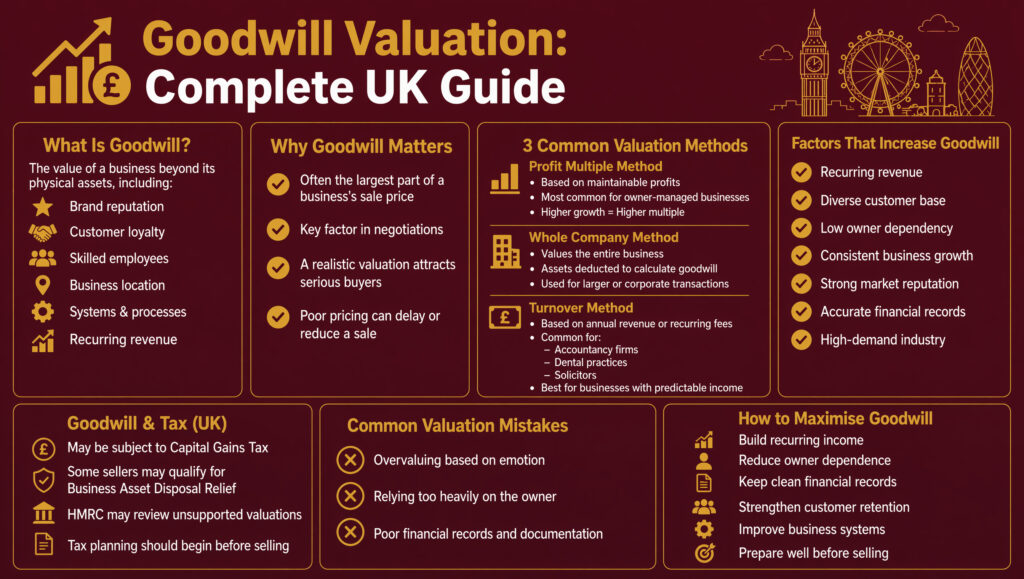
Goodwill is an intangible asset. It represents the value of a business that exists beyond its physical assets and identifiable intellectual property. Brand reputation, customer relationships, supplier connections, staff expertise, location advantages, and operational systems all contribute to it.
You cannot see goodwill on a balance sheet until a transaction crystallises it. A business with strong recurring revenue, a loyal customer base, and a well-known name can be worth significantly more than the sum of its equipment, stock, and property. That gap is what buyers are paying for when they acquire an established business rather than starting one from scratch.
Why Goodwill Matters in a Business Sale
For most service-based businesses and many trading businesses, goodwill accounts for the majority of the sale price. A solicitor’s practice, an accountancy firm, a dental practice, a marketing agency, a consultancy: the tangible assets in each of these is a fraction of what the business is actually worth.
Buyers know this. So do their advisers. Goodwill is the most negotiated and most scrutinised component of any business sale because it is the area where a seller’s view and a buyer’s view are most likely to diverge. A sensible valuation supported by clear evidence holds. A figure based on what the seller thinks the business should be worth rarely does.
Methods of Goodwill Valuation
The Simple Multiple Method
The simple multiple method is the most common approach for owner-managed businesses. Goodwill is calculated by applying a multiplier to the business’s maintainable profits, with the owner’s notional remuneration added back to give a normalised profit figure.
The multiplier itself reflects the business’s growth, profitability, and risk profile. A business with strong recent growth and a stable client base will attract a higher multiple than one in decline or heavily reliant on the owner’s personal involvement. The method is widely used because it is simple, well understood, and produces a defensible figure when applied properly.
The Whole Company Method
The whole company method values the business in its entirety, then deducts the value of tangible and identifiable intangible assets to arrive at goodwill. It is more commonly used for larger businesses and for transactions involving private equity buyers or corporate acquirers.
The advantage is that it captures the full value of the business as a going concern rather than focusing only on profits. The disadvantage is that it requires a more detailed underlying valuation, often involving discounted cash flow analysis or comparable transaction data, which makes it more expensive to produce and more open to challenge during negotiation.
The Turnover Method
The turnover method applies a multiplier to gross fees or revenue rather than to profit. It is the standard approach in professional practice sales, including accountancy practices, solicitors’ firms, and dental practices, where recurring fee income is the primary value driver.
The multiplier here is typically lower than the profit-based multiple because it is applied to a larger base figure. Different sectors have established benchmarks. The method works well for businesses with stable, predictable recurring revenue. It works poorly for businesses with high one-off project income or volatile turnover.
What Affects the Value of Goodwill
Several factors move the goodwill figure up or down:
- Recurring revenue: Predictable, contracted income carries a higher value than one-off or project-based revenue
- Customer concentration: A diverse customer base is worth more than one where a small number of clients represent most of the income
- Owner dependency: A business that runs without the owner attracts a higher multiple than one where everything stops if the owner steps away
- Growth trajectory: Consistent year-on-year growth supports a higher multiple
- Market position: A recognised brand or strong local market position adds value
- Quality of financial records: Three years of clean, well-documented accounts allow buyers and their advisers to verify the underlying numbers
- Sector dynamics: Industries with strong M&A activity and high buyer demand command higher multiples than declining sectors
The goodwill in a business is not fixed. The same business prepared differently can command a meaningfully different valuation. That is why preparation in the years before sale matters so much.
Goodwill, Tax, and HMRC
Goodwill carries specific tax implications that need to be planned before a sale, not addressed after it.
Where goodwill is sold by an individual or a partnership, the proceeds are subject to capital gains tax. Sellers who qualify may claim Business Asset Disposal Relief under the Taxation of Chargeable Gains Act 1992, which reduces the rate of capital gains tax on qualifying gains. The criteria for relief are specific and need to be assessed in advance.
For corporate sellers, the position is more complex. The tax treatment depends on when the goodwill was created and acquired. Goodwill acquired by a company before April 2002 is generally treated under the capital gains regime. Goodwill acquired after April 2002 falls under the intangible fixed assets regime under the Corporation Tax Act 2009, with corresponding implications for both seller and buyer.
HMRC’s Shares and Assets Valuation team is responsible for agreeing goodwill valuations where the sale figure is challenged. Inflated or unsupported goodwill valuations can trigger an enquiry and an adjustment. The valuation needs to be defensible against HMRC scrutiny as well as against the buyer’s negotiating position.
Common Mistakes in Goodwill Valuation
Three mistakes recur in business sales involving goodwill.
The first is emotional overvaluation. Owners with significant personal investment in the business tend to value goodwill at what they feel it represents to them rather than what a buyer will reasonably pay. The result is a figure that does not attract serious offers.
The second is ignoring owner dependency. A business where the owner is the primary client relationship manager, the lead practitioner, and the operational backbone carries reduced goodwill. Buyers price this in. Sellers who fail to address it before going to market lose value they did not need to lose.
The third is poor documentation. Goodwill that cannot be evidenced through clean financial records, client retention data, and operational systems does not survive due diligence. The figure in the marketing brochure has to be defensible when the buyer’s accountant and solicitor start asking questions.
How Blackmont Legal Helps
Goodwill valuation is part of every business sale. The legal documentation around it determines whether the figure agreed at the headline level is the figure that lands in your account after completion.
At Blackmont Legal, we advise sellers and buyers on the legal side of business sales involving goodwill. We structure deals to protect the seller’s tax position where possible, draft warranties and indemnities to allocate risk appropriately, and manage the disclosure process so the goodwill figure agreed in the sale documents holds. We work alongside accountants and brokers so the valuation work and the legal work move together, not in conflict.
Call 0333 305 9957 or email [email protected].
Frequently Asked Questions
What is goodwill in business valuation? The intangible value of a business beyond its tangible assets, covering brand reputation, customer relationships, market position, and operational systems.
How is goodwill calculated? Three main methods are used in the UK: A multiple of maintainable profits, a multiple of turnover, or the whole company method which values the business as a whole and deducts identifiable assets.
Why is goodwill important in a business sale? For most established businesses, goodwill represents the majority of the sale price. It is also the most negotiated component because buyer and seller views often differ significantly.
What affects the value of goodwill? Recurring revenue, customer concentration, owner dependency, growth trajectory, market position, financial record quality, and sector M&A activity all move the goodwill figure up or down.
Is goodwill subject to tax when a business is sold? Yes. For individuals and partnerships, capital gains tax applies. Business Asset Disposal Relief may reduce the rate where the seller qualifies. For corporate sellers, the treatment depends on when the goodwill was created.
Does HMRC challenge goodwill valuations? Yes. HMRC’s Shares and Assets Valuation team agrees goodwill valuations where the figure is contested. Inflated or unsupported valuations can trigger an enquiry.
Should I get professional advice on goodwill valuation? Yes. Goodwill valuation combines commercial judgement, tax planning, and legal protection. Getting it wrong affects both the sale price and the net proceeds you walk away with.