
Buying a dental practice is one of the most significant decisions you will make as a clinician. It is also more complicated than most first-time buyers expect. Regulatory approvals, NHS contracts, due diligence, financing, and the deal structure all need to come together in the right order. Get any of them wrong and the transaction either fails or completes on terms that cost you for years. This guide covers what to think about before you commit, who can buy, what the process looks like, and where the legal complexity sits.
Should I Buy a Dental Practice
Practice ownership is a meaningful step up from working as an associate. The financial upside is real, but so is the operational responsibility.
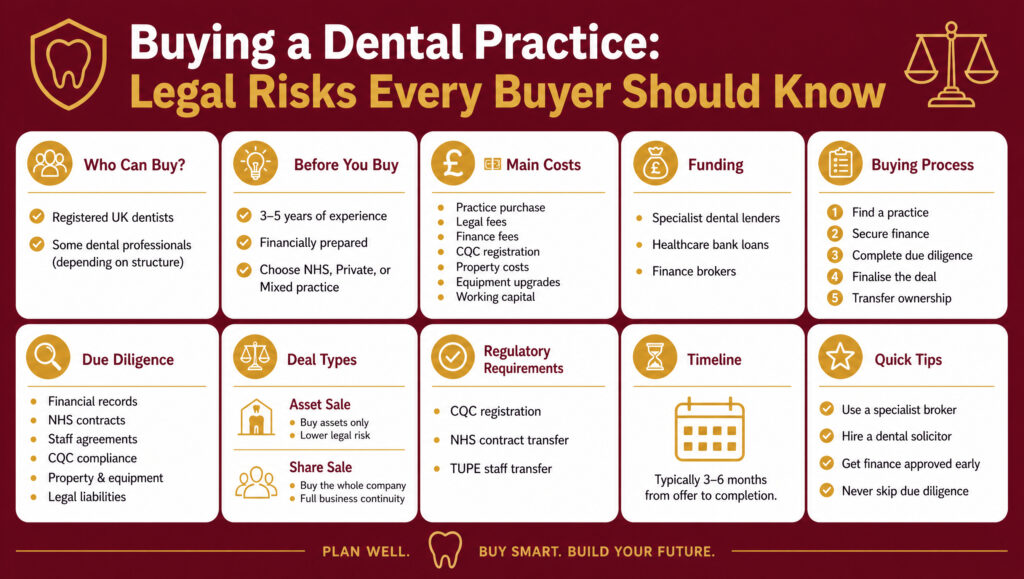
Most sellers and lenders prefer buyers with at least 3 to 5 years of post-qualification experience. Beyond clinical capability, lenders and sellers also assess whether you have managed staff, handled treatment planning at scale, and understand the operational side of running a practice. The day-to-day reality of ownership, including HR issues, supplier relationships, compliance audits, and patient escalations, will arrive faster than most first-time buyers expect.
Buying makes sense if you are clinically experienced, financially prepared, and genuinely want what comes with ownership. If you are buying because it feels like the next step rather than because you want the responsibility, take more time before committing.
Who Can Buy a Dental Practice
Practice ownership in the UK is regulated. Under General Dental Council rules, only registered dental professionals can own a dental practice. This typically means dentists, though in certain structures other registered dental care professionals may have an ownership interest.
Non-dentists cannot own a dental practice in their own right. They can hold non-clinical roles in the business, providing finance, marketing, or HR support, but the ownership structure must comply with GDC requirements. Corporate dental groups operate under specific regulatory structures that allow for wider ownership but still require qualified dental professional involvement at the clinical leadership level. Hygienists and therapists looking to own a practice should take specific regulatory advice as the position depends on the structure and the services provided.
What Does It Cost
Purchase Price and Valuation
The price depends on the practice’s profitability, patient base, location, and revenue mix. Two valuation methods dominate in the UK: the EBITDA multiple and the goodwill percentage of gross fees.
EBITDA multiple is the dominant approach. The practice’s earnings before interest, tax, depreciation, and amortisation are multiplied by a figure reflecting market conditions and buyer type. Independent buyers typically pay lower multiples than corporate or DSO buyers, but with simpler deal structures and no stay-on requirements.
Several factors move the multiple. Location matters: London, South East, Wales, and Midlands command higher valuations. Revenue mix matters: a strong private element with growth potential is increasingly valued over pure NHS practices. Provider risk matters significantly: A practice where the principal performs the majority of clinical work carries a heavier discount than one with stable associate capacity. Financial record quality and CQC compliance history also affect the figure.
Additional Costs
The purchase price is not the only cost to budget for. A realistic acquisition budget includes several categories beyond the deal itself.
- Legal fees: Specialist dental solicitor costs for due diligence, contract negotiation, and completion
- Broker fees: Where applicable, though most broker commission is paid by the seller
- Accountant fees: Financial due diligence and tax structuring advice
- CQC application fees: Payable on a new registration
- Property costs: Surveys, valuations, and legal fees if the freehold is included
- Bank arrangement fees: Where finance is being used
- Refurbishment or equipment upgrade costs: If the practice needs investment after completion
- Working capital reserves: To cover the first months of operation under your ownership
Failing to budget for these categories is one of the most common first-time buyer mistakes. The headline purchase price is the start of your acquisition cost, not the total.
Funding Options
Most buyers finance practice purchases through specialist healthcare lenders rather than high-street banks. The major UK banks have dedicated healthcare teams that understand dental valuations and the regulatory framework around practice ownership.
Specialist dental lenders typically offer better terms than generalist lenders. A specialist finance broker can access lenders not available through direct application and structure the finance package to your circumstances. Lenders assess the practice’s viability, the buyer’s clinical and management experience, and the deal structure before committing. Pre-assessment by a finance broker before you start making offers is strongly recommended.
How to Buy a Dental Practice Step by Step
Finding the Right Practice
Specialist dental brokers control most of the practice sales market. Register with multiple brokers as a potential buyer to get early notification of practices that match your criteria. Word of mouth and direct approaches also produce opportunities, particularly in tight regional markets.
Before viewing practices, define what you want: NHS, private, or mixed. Geographic area. Freehold or leasehold. Single-surgery or multi-surgery. The clearer your brief, the faster brokers can match you to suitable opportunities.
Due Diligence
Due diligence is where you find out what you are actually buying. Your solicitor serves a formal questionnaire on the seller’s solicitor covering financial performance, NHS contract details, staff and associate agreements, lease or freehold position, CQC compliance history, equipment, patient records, and any outstanding litigation.
Financial due diligence verifies the practice’s reported turnover and EBITDA, identifies add-backs, and assesses income sustainability. Legal due diligence covers contracts, regulatory standing, and any liabilities the buyer would inherit. Issues uncovered either get resolved before completion, get reflected in the price, or result in the buyer walking away.
Deal Structure
A dental practice sale is structured either as an asset sale or a share sale. In an asset sale, you buy the practice’s assets, including equipment, goodwill, and patient records, but not the company itself. In a share sale, you buy the company’s shares and take on its full legal history.
For buyers, an asset sale typically gives more control over what is acquired and leaves most historical liabilities with the seller. A share sale is often simpler from a commercial continuity perspective but requires more thorough due diligence. Tax implications differ significantly. Take specialist tax advice before agreeing the structure.
Completion
Completion involves the formal transfer of ownership, the release of funds, the signing of the share purchase agreement or asset purchase agreement, and the satisfaction of all conditions precedent. CQC registration transfer and NHS contract transfer often run in parallel and can affect the timeline.
Your solicitor manages completion, coordinates with the seller’s solicitor and lender, and ensures that nothing transfers until everything required has been delivered. Most UK dental practice acquisitions complete in 3 to 6 months from offer acceptance.
Regulatory Requirements
CQC Registration
Every change of ownership of a dental practice triggers a new CQC registration. The Care Quality Commission assesses the new provider’s fitness, governance arrangements, and compliance systems before approval.
CQC applications typically take 10 to 16 weeks to process from submission. Start the application as soon as your offer is accepted. Delays in CQC approval are one of the most common reasons completion dates slip.
NHS Contracts
NHS contracts do not transfer automatically when a dental practice changes hands. In an asset sale, the buyer applies to NHS England for a new contract or a variation of the existing one. In a share sale, the contract may remain in place if the legal entity holding it does not change, but NHS England still needs to be notified and may require a variation.
NHS contract reforms effective from April 2026 introduced new delivery requirements including allocation of contract value to urgent and unscheduled activity. Buyers acquiring NHS or mixed practices need to assess deliverability under the new terms as part of due diligence.
TUPE
Under the Transfer of Undertakings (Protection of Employment) Regulations, all employees of the practice transfer to the new owner on their existing terms and conditions. This includes dental nurses, reception staff, and practice managers. Continuity of service, pension entitlements, and any outstanding HR issues transfer with them.
Associate dentists working as self-employed contractors are not covered by TUPE, but their agreements need to be reviewed and novated as part of the transaction. The seller is required to inform and consult affected employees before completion. Failure to comply creates tribunal exposure and significant financial liability for the new owner.
Buying a Dental Practice in Manchester
Manchester is one of the strongest UK markets outside London for dental practice acquisitions. A large patient population, growing private demand, and an active business environment make it consistently attractive to first-time buyers and existing owners looking to expand. Independent buyers dominate the Manchester market, though corporate and DSO activity has increased in recent years.
Buyers focused on Manchester should engage specialist brokers active in the North West, instruct a Manchester-based solicitor with dental sector experience, and factor in the regional valuation profile, which can differ from London and the South East.
How Blackmont Legal Helps
Buying a dental practice involves legal complexity at every stage, from CQC and NHS requirements to TUPE compliance, warranties, and post-completion obligations. Getting any of these wrong costs significantly more to fix than to get right.
At Blackmont Legal, we advise buyers on the legal side of dental practice acquisitions from the moment a target is identified through to completion. We conduct legal due diligence, draft and negotiate the transaction documents, manage CQC and NHS contract transfer, and handle TUPE consultation. We work alongside specialist dental brokers, finance brokers, and accountants so the legal work supports your deal rather than slowing it down.