
You have built a valuable asset. But the gap between what you think your practice is worth and what you actually walk away with can be significant. Costs erode the headline figure. Structure determines your tax bill. Preparation moves the multiple. This guide covers the real numbers, the real timeline, and the decisions that determine what you actually cash out.
Is 2026 a Good Time to Sell a Dental Practice?
Buyer demand remains strong. The Bank of England base rate stood at 3.75% in December 2025, improving buyer affordability. According to Dental Elite’s 2026 market analysis, the market is characterised by steady, sustainable activity rather than volatility.
Between 60% and 80% of transactions are completed by independent buyers. Corporate and DSO buyers account for under 10%, though larger corporates are expected to re-enter the acquisition market through 2026. NHS contract reforms effective April 2026 have introduced both opportunity and uncertainty for mixed practices. Buyers are scrutinising contract deliverability more closely, but demand for stable NHS income remains strong, per Dental Practice Sales’ reforms analysis. Regionally, London, South East, Wales, and Midlands command the highest valuations. Some Northern practices have reported 37 or more viewings and 27 or more offers.
How Much Is Your Dental Practice Worth?
Two primary methods. The NASDAL goodwill benchmark sits at approximately 124% of gross fees as of July 2025. The EBITDA multiple method is now dominant: independent buyers apply 2.5 to 4.5x EBITDA, corporate buyers 7 to 7.5x EBITDA. The average independent transaction sale price is approximately £792,711.
What moves the multiple: location, NHS versus private mix, financial record quality, provider risk, associate stability, CQC compliance, and scalability. Practices where the owner performs 90% or more of production may see valuation reductions of 10 to 20%, per Dental Pitch Brokerage.
What It Actually Costs to Sell a Dental Practice
| Cost Item | Typical Range |
|---|---|
| Broker commission | 1.5% to 3% of sale price |
| Accountant / NASDAL valuation | £2,000 to £5,000 |
| CQC registration transfer | £2,638 (2025/26 rate) |
| Other costs | £1,000 to £3,000 |
On a £792,000 sale, total costs typically run between £25,000 and £45,000, approximately 3% to 6% of the sale price before tax.
Case Study: A Dental Practice Sale
Practice: Mixed NHS and private, South Manchester. Gross fees £650,000. EBITDA £195,000. Three associates. Clean CQC record.
Valuation: 4x EBITDA multiple (independent buyer): £780,000. Goodwill cross-check at 124%: £806,000. Agreed price: £792,000.
Costs deducted: Broker (2%): £15,840. Legal: £9,500. Accountant: £3,200. CQC: £2,638. Sundry: £1,500. Total: £32,678.
Gross proceeds before tax: £759,322. The seller elected a share sale and qualified for Business Asset Disposal Relief under the Taxation of Chargeable Gains Act 1992, paying capital gains tax at 10% on qualifying gains. Net proceeds after tax: approximately £680,000 to £700,000. Timeline from broker instruction to completion: 8 months.
Asset Sale vs. Share Sale
In an asset sale, the buyer purchases the practice’s assets: equipment, goodwill, patient records, and contracts. In a share sale, the buyer purchases the company’s shares and takes on its full legal history.
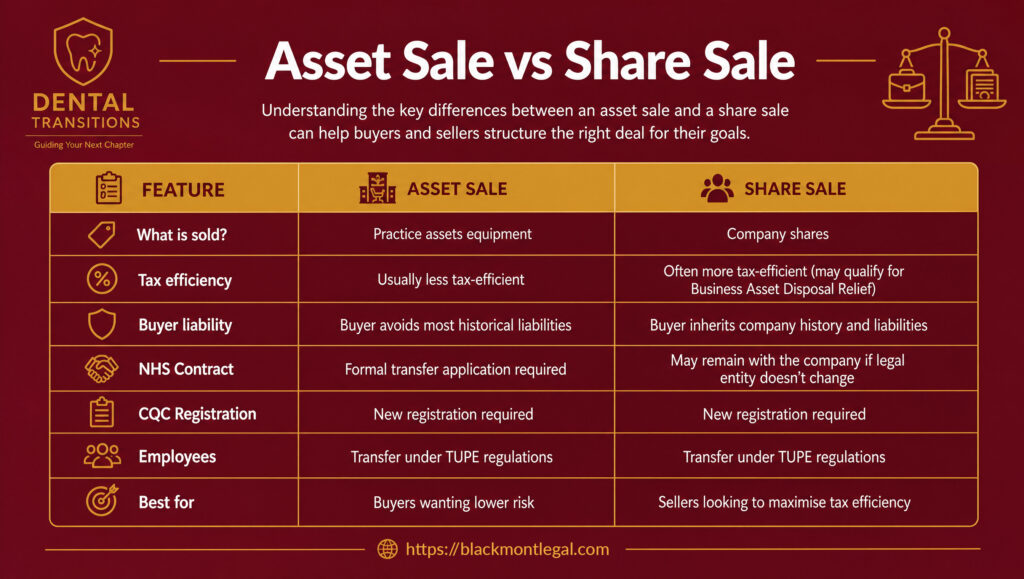
For sellers: A share sale is typically more tax-efficient through Business Asset Disposal Relief. For buyers: An asset sale gives more control and excludes most historical liabilities. Both structures require a new CQC registration for the buyer. NHS contract transfer under an asset sale requires a formal application to NHS England. Under a share sale, the contract may remain in place if the legal entity does not change. Under both, TUPE regulations transfer all employees to the new owner on their existing terms.
Month-by-Month Timeline
| Month | Activity |
|---|---|
| 1 to 2 | Engage broker, obtain valuation, instruct solicitor |
| 3 to 4 | Go to market, viewings, initial offers |
| 5 | Accept offer, begin due diligence |
| 6 to 7 | Due diligence, negotiate documents, CQC application |
| 8 | Legal completion, NHS notification |
| 9 | CQC confirmed, NHS transfer finalised, handover begins |
Average total: 4 to 9 months from offer to completion. Complex deals sit at the longer end.
Independent Buyer vs. Corporate Buyer
Independent buyers (60 to 80% of transactions): lower multiple at 2.5 to 4.5x EBITDA, but faster transactions, no stay-on requirement, no earn-out.
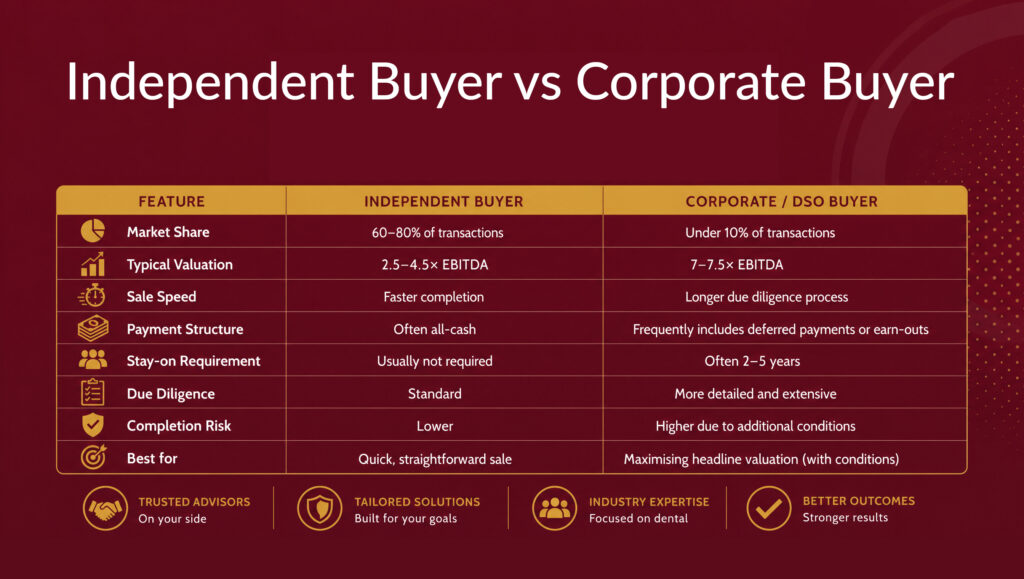
Corporate and DSO buyers (under 10%): higher multiple at 7 to 7.5x EBITDA, but typically require the seller to stay 2 to 5 years post-completion. Due diligence is significantly more intensive.
An all-cash offer from an independent buyer at 4x EBITDA may net more than a corporate offer at 7x once the stay-on, earn-out risk, and deferred consideration are factored in. Model both scenarios before accepting.
Handling Multiple Offers
Compare full terms, not headline price. Payment structure, earn-out conditions, stay-on requirements, price adjustment mechanisms, and funding status all matter. An offer subject to finance carries more completion risk than cash. An earn-out ties part of your payment to post-sale performance you no longer control. Your broker manages the offer process. Your solicitor negotiates the legal terms. Both need to be involved before you indicate acceptance.
How Preparation Affects Your Sale Price
Three or more years of clean financial records are the single most consistent factor in achieving the top of the valuation range. EBITDA optimisation in the 2 to 3 years before sale, reducing owner-dependency, building associate capacity, controlling costs, can move the multiple meaningfully. On an EBITDA of £195,000, the difference between a 3x and 4x multiple is £195,000 in sale proceeds. The return on 12 months of preparation is rarely matched by any other investment a practice owner can make.
Life After the Sale
Completion day is not the end. Patient communication goes out under the new owner’s name. Staff are introduced to the new principal. Clinical systems transfer. Most sellers remain for a handover period of 4 to 12 weeks for independent transactions. Corporate deals involve longer contractual stay-on periods. Post-sale financial planning should be addressed before completion, not after.
How Blackmont Legal Helps
At Blackmont Legal, we advise dental practice owners on the legal side of practice sales from planning through to completion. We advise on deal structure, draft and negotiate transaction documents, manage due diligence, and handle TUPE, CQC, and NHS contract requirements. We work alongside specialist dental brokers and NASDAL accountants to make sure the legal work does not delay or undermine the outcome you have worked for.