

Most M&A deals fail. Not occasionally, between 70% and 90% of them depending on which research you read. Businesses spend trillions on acquisitions every year, and the majority do not get back what they put in. This article breaks down why, and what businesses can do differently.
What Is a Merger and Acquisition?
A merger is when two businesses combine into one. An acquisition is when one business buys another, absorbing it or running it separately. Both carry significant legal, financial, and commercial complexity, and both carry serious risk without the right preparation.
Businesses pursue M&A for many reasons. Faster growth, access to new markets, acquiring talent or technology, preparing for an exit. When the motive is clear and commercially grounded, deals tend to hold together. When it is vague or driven by competitive pressure rather than genuine strategic logic, the deal is already in trouble before anyone has signed anything.
How Many M&A Deals Fail?
Global Failure Rate
Harvard Business School puts the failure rate at between 70% and 90%. A 2024 analysis in Fortune, covering over 40,000 acquisitions across four decades, confirmed that 70 to 75% of deals fail to achieve their stated objectives.
The examples are well known. AOL and Time Warner merged in 2001 for $65 billion in what became one of the worst corporate deals in history. Google acquired Motorola for $12.5 billion in 2012 and sold it two years later for $2.9 billion. Microsoft bought Nokia’s mobile division for $7 billion in 2013, wrote off $7.6 billion, and cut nearly 10,000 jobs.
M&A Failures in The UK
McKinsey research found that around 10% of large UK M&A deals are cancelled before they even close. For SMEs the risks are sharper. Smaller businesses often lack the internal resource to manage a deal properly while still running the business. The Solicitors Regulation Authority has issued formal warning notices about businesses making multiple acquisitions without adequate due diligence or integration planning, citing it as a direct cause of commercial harm.
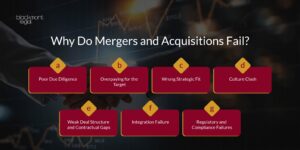
Why Do Mergers and Acquisitions Fail?
Rarely one reason. Most failed deals involve several overlapping problems, some visible before signing and some that only surface after.
Poor Due Diligence
Buyers do not always know what they are buying. Financial due diligence gets most of the attention. Legal, commercial, and operational review gets less, and that is where the real exposure sits. Undisclosed litigation, IP ownership disputes, employment liabilities, and data protection issues routinely surface after completion at a cost far exceeding what a proper pre-deal review would have required.
Overpaying for the Target
The deal makes sense at one price and stops making sense at another. Competitive processes push prices beyond rational levels, and advisers with a financial interest in closing present synergy projections that rarely survive contact with reality. Price discipline erodes quickly under pressure, and buyers who pay too much start the relationship with a valuation gap they may never close.
Wrong Strategic Fit
If the rationale for a deal cannot be explained simply, it probably should not happen. Conglomerate acquisitions, where buyer and target operate in unrelated industries, account for nearly 40% of all acquisitions globally. Most fail. There are no operational synergies to unlock, no shared customer base, no combined expertise. Buyers who acquire operationally weak businesses believing strong management can turn them around are consistently wrong.
Culture Clash
Culture does not announce itself as a problem on day one. It shows up later in attrition, slowing decision-making, and deteriorating client service. The Daimler-Chrysler merger was legally one entity. Functionally it never became one. Two businesses with incompatible management philosophies were forced together, and the human friction eventually overwhelmed the strategic rationale. The business was sold for a fraction of its acquisition price.
Weak Deal Structure and Contractual Gaps
The documents govern what you actually own and what recourse you have when things go wrong. Warranties and indemnities drafted too broadly may be unenforceable. Too narrowly, they may not cover what actually materialises. Most post-completion disputes in M&A trace back to ambiguous contract language, not deliberate misconduct.
Integration Failure
Completion is not the finish line. After signing, two businesses are legally one entity but operationally still two, running parallel systems and duplicating effort while key people start to weigh their options. The window for capturing the synergies that justified the deal closes fast. Integration consistently sits at the top of every list of M&A failure causes, and the human dimension receives the least investment.
Regulatory and Compliance Failures
In the UK, the Competition and Markets Authority can review transactions meeting certain turnover or market share thresholds. Missing this at the planning stage adds delay, cost, and sometimes gets the deal blocked entirely. For regulated sector acquisitions, the buyer inherits the target’s obligations from day one. The Axiom Ince situation showed what happens when that is ignored: frozen accounts and serious client harm. Regulatory risk is not an administrative detail.
How to Strengthen Your M&A Deal
Conduct Thorough Due Diligence
Cover legal, financial, commercial, and operational risk. Legal due diligence must examine contracts, IP ownership, employment obligations, regulatory standing, and litigation history. These are the foundations of what you are buying, not secondary concerns.
Get the Deal Structure Right
Warranties need to match the real risks of the transaction. Indemnities need to cover genuine exposure. Ambiguous drafting in earn-outs and completion accounts is where most post-deal disputes begin. The time to get this right is before signing.
Plan Integration Early and Address Culture
Start integration planning before heads of terms are agreed. Identify the people whose retention is critical and have those conversations early. Assess cultural compatibility with the same rigour applied to legal and financial review. It is one of the most reliable indicators of post-deal risk.
Manage Regulatory Risk from the Start
Assess CMA thresholds at the outset of deal planning. For regulated sector acquisitions, map compliance obligations before completion. Regulatory surprises in M&A are almost always the result of insufficient preparation.
How Blackmont Legal Helps You Get M&A Right
Most M&A mistakes happen because businesses enter deals without proper legal support from the outset.
At Blackmont Legal, we advise across the full M&A lifecycle. We conduct legal due diligence that identifies liabilities and contractual gaps before they become problems. We structure deals to protect your position, draft warranties and indemnities that hold, and manage disclosure so there are no surprises after signing. We also work with businesses preparing for acquisition, helping founders get contracts clean, IP clear, and governance solid before a deal process begins.
If you are considering an acquisition, exploring a merger, or preparing for sale, speak to us before the process starts.
Call 0333 305 9957 or email [email protected].
Frequently Asked Questions
What is the M&A failure rate?
Between 70% and 90% globally. A 2024 analysis of over 40,000 deals confirmed that 70 to 75% fail to achieve their stated objectives.
What is the most common reason M&A deals fail?
Integration failure. Most deals that survive due diligence and legal structuring fall apart in the operational phase after completion.
What does due diligence involve in M&A?
Legal, financial, commercial, and operational review of the target business, covering everything from contracts and IP to regulatory standing and employment obligations.
Do UK acquisitions need regulatory approval?
Some do. The CMA can review transactions meeting certain thresholds. Regulated sector acquisitions may require additional approvals. Assess this at the outset, not the end.
How does a solicitor add value in M&A?
By advising on structure, conducting legal due diligence, drafting transaction documents, managing disclosure, and identifying regulatory risk early in the process.