

Legal risk does not announce itself. It builds quietly across every stage of a deal, and by the time it surfaces, the cost of fixing it is almost always higher than the cost of catching it early. This article walks through where legal risk appears in an M&A transaction and what businesses can do at each stage to stay protected.
How Legal Work Protects Your M&A Deal
Every buyer going into an M&A deal thinks about money. What the business is worth, what they are paying, what the return looks like. The legal side gets treated as a support function, something that runs alongside the deal rather than sitting at the centre of it.
That framing is where a lot of deals unravel. A business can be financially sound and still carry a supplier contract that collapses on change of ownership, a trademark registered to the wrong entity, an employment liability nobody flagged, or a regulatory obligation the buyer only discovers after completion. None of those show up in the financial model. All of them affect what the deal is actually worth.
Legal risk in M&A is not one thing. It shifts depending on where you are in the transaction. What needs to be found before heads of terms is different from what needs to be negotiated during the deal, which is different again from what needs to be protected against after completion. That timeline is the most useful way to understand it.
Legal Risks Before the Deal
The risks that cause the most damage are usually present before heads of terms are agreed. Finding them early is the entire point of pre-deal legal work.
Inadequate Due Diligence
Due diligence is where legal risk is supposed to be found and priced. When it is rushed or scoped too narrowly, the buyer inherits problems they had no idea existed.
Legal due diligence needs to cover contracts, IP ownership, employment obligations, litigation history, regulatory compliance, and any consents required to transfer the business. Financial due diligence alone will not surface a supplier contract that terminates on change of ownership, a trademark the seller does not actually own, or a data protection breach the target has not disclosed. Each of those belongs in the pre-deal review. Finding them afterwards is a different conversation entirely.
IP Ownership and Licensing Gaps
IP is frequently a core part of what a buyer is paying for, and its ownership is far less clean than it looks. Software built by contractors may not have been properly assigned. Trademarks may be registered to the wrong entity. Licences may carry restrictions that prevent transfer after acquisition. Identifying these gaps before the deal closes gives the buyer room to negotiate a fix or adjust the price. After completion, the options narrow considerably and the costs go in one direction.
Regulatory and Competition Clearance
Some transactions require regulatory approval before they can complete, and failing to identify this at the outset is a serious problem. In the UK, the Competition and Markets Authority can review deals meeting certain turnover or market share thresholds. Regulated sectors carry additional requirements on top of that.
A buyer who discovers a mandatory regulatory review two weeks before planned completion has already lost control of the timeline. For some deals, this assessment needs to happen before the letter of intent is even signed. It is not an administrative formality. It is a deal variable.
Legal Risks During the Deal
Once the deal is in motion, legal risk shifts from discovery to allocation. The negotiation phase determines who bears what exposure if things go wrong.
Warranty and Indemnity Exposure
Warranties and indemnities are the main mechanism for allocating legal risk between buyer and seller, and the detail matters far more than most buyers appreciate until something goes wrong. A warranty is a statement by the seller that a particular fact about the business is true. An indemnity is a direct promise to compensate for a specific liability if it materialises. The scope of each, the liability caps, the survival periods, and the disclosure process together determine whether the buyer is genuinely protected or just appears to be. Warranties drafted too broadly may be unenforceable. Gaps in the indemnity schedule leave real exposure with no route to recovery. Getting this right is not a drafting exercise. It is where the legal protection actually lives.
Contract Assignment and Third-Party Consents
Commercial contracts do not automatically transfer with a business. Key supplier agreements, customer contracts, licences, and leases may all include change of control or assignment clauses requiring the consent of the other party before they can move to a new owner.
This is a mechanical legal risk. It is entirely avoidable with proper pre-completion work, and entirely disruptive if it is missed.
Employment Law and TUPE
TUPE means employees of the target transfer to the buyer on their existing terms and conditions. That is not negotiable, and it applies regardless of what the buyer intended. Pension liabilities, outstanding tribunal claims, and poorly drafted employment contracts all transfer with the business. Understanding the full employment picture before completion, and building appropriate protections into the transaction documents, is not optional for any UK acquisition.
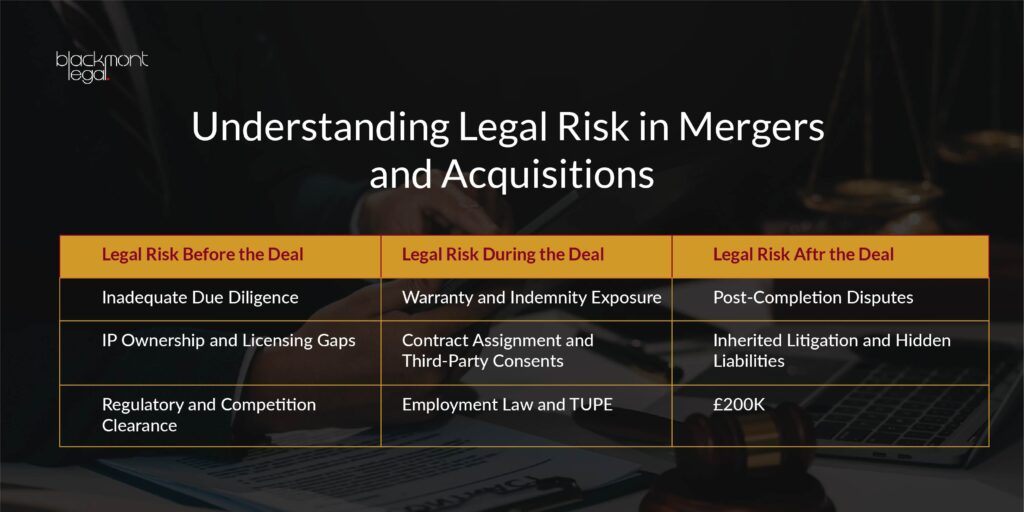
Legal Risks After Completion
Closing the deal does not close the legal risk. Some of the most significant exposure only becomes visible once the transaction is complete.
Post-Completion Disputes
Disputes after completion almost always originate in the transaction documents. Earn-out mechanisms, completion accounts, and price adjustment clauses are frequent sources of disagreement when parties interpret the same drafting differently six months after signing. Warranty claims take time to crystallise. A misrepresentation about the financial position of the business may not become apparent until the first full set of post-completion accounts. Having clear documents with defined dispute resolution mechanisms is not a nice-to-have. It is what determines whether a dispute costs thousands or millions to resolve.
Inherited Litigation and Hidden Liabilities
The buyer steps into the seller’s shoes, which includes any litigation the target was facing, regulatory investigations that were ongoing, and liabilities that were not disclosed during due diligence. Thorough pre-deal legal work reduces this risk significantly. Properly scoped warranties and indemnities in the transaction documents provide a route to recovery if something material was missed or concealed. Without both, the buyer absorbs the loss with no mechanism to push it back.
How Blackmont Legal Helps You Manage Legal Risks in M&A
Legal risk in M&A is manageable with the right expertise at the right stage.
At Blackmont Legal, we advise buyers and sellers across the full M&A lifecycle. We conduct legal due diligence that surfaces risks before they become liabilities, structure warranties and indemnities that provide real protection, and handle the regulatory and employment issues that catch businesses out after completion. We also work with sellers preparing for a deal process, getting contracts, IP, and governance clean before a buyer starts asking questions.
Get legal advice before the process starts. The risks are far easier to manage before a deal is in motion than after.