If you sell goods on credit, a retention of title clause can be the difference between getting your stock back and joining the queue as an unsecured creditor when a customer goes insolvent. The clause keeps legal ownership of the goods with the seller until the buyer pays. That sounds simple. In practice, retention of title is one of the most heavily litigated areas of commercial contract law, and most clauses fail when they are needed most because they were poorly drafted, never properly incorporated, or attempted to do more than the law allows.
What Is a Retention of Title Clause
A retention of title clause is a contractual term that allows the seller to retain legal ownership of goods after delivery until the buyer has paid for them in full. It is sometimes called a reservation of title clause, a Romalpa clause (after the landmark case that established the principle in English law), or simply a ROT clause.
The clause works alongside the Sale of Goods Act 1979, which under section 19 allows a seller to reserve the right of disposal of goods until certain conditions are met. Without a ROT clause, ownership of goods passes to the buyer on delivery or at the point specified in the contract. With one, the seller keeps title and can reclaim the goods if payment is not made.
On a buyer’s insolvency, a properly drafted and enforced ROT clause keeps unpaid goods out of the insolvent estate. The seller recovers their property rather than submitting a claim as an unsecured creditor, which in most insolvencies returns pennies in the pound if anything at all.
Types of Retention of Title Clause
Basic ROT Clause
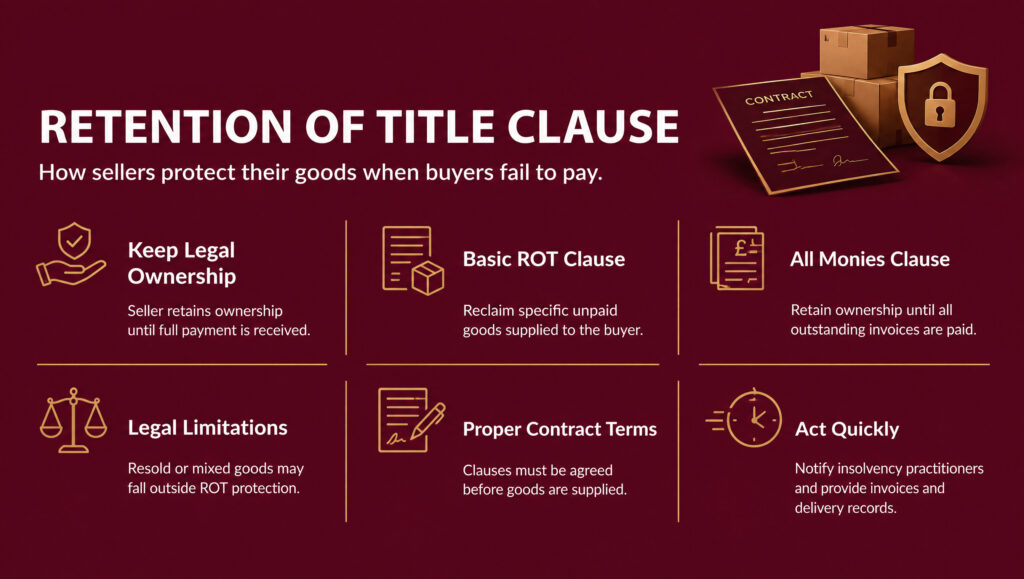
A basic clause retains ownership of specific goods until the buyer pays for those particular goods. It is the most straightforward type and the easiest to enforce. The seller’s right is limited to the goods supplied under the specific order that remains unpaid.
A basic clause should include the seller’s right to enter the buyer’s premises and repossess the goods, a requirement that the buyer stores the goods separately and keeps them identifiable as the seller’s property, and a provision that the buyer holds the goods as bailee until title passes. Without these supporting terms, even a basic clause can be difficult to enforce in practice.
All Monies Clause
An all monies clause extends retention of title beyond the specific goods in a single order. It retains ownership of all goods supplied by the seller until the buyer has paid every outstanding balance owed to the seller, across all orders and all invoices.
This is significantly more powerful than a basic clause because it prevents a buyer from cherry-picking which invoices to pay while retaining goods from other orders. English courts have upheld all monies clauses, including in Armour v Thyssen Edelstahlwerke AG (1991), where the House of Lords confirmed that an all monies clause does not create a registrable charge and is enforceable as a straightforward reservation of title. The clause should be drafted as a standalone provision with a severance clause so that if any part of a wider ROT clause is struck down, the all monies element survives independently.
Proceeds of Sale Clause
A proceeds of sale clause attempts to extend the seller’s rights to the money the buyer receives when the buyer resells the goods before paying for them. In theory, the seller can trace its interest from the goods into the sale proceeds.
In practice, proceeds of sale clauses are extremely difficult to enforce under English law. Courts have consistently treated them as creating a charge over the proceeds rather than a simple reservation of title. Under the Companies Act 2006, a charge created by a company must be registered at Companies House. An unregistered charge is void against a liquidator, administrator, or other creditor. Most sellers do not register proceeds clauses as charges, which makes them unenforceable precisely when they are needed most.
Mixed Goods Clause
A mixed goods clause attempts to retain or create rights over goods that have been incorporated into a manufacturing process or combined with other materials. If the buyer uses the seller’s raw materials to manufacture a new product, the original goods lose their identity. A basic ROT clause ceases to apply because the goods no longer exist in their original form.
Courts have treated mixed goods clauses in the same way as proceeds clauses. Where the clause gives the seller an interest in a new product, that interest is treated as a charge requiring registration. The leading authority is Borden (UK) Ltd v Scottish Timber Products Ltd (1981), where the Court of Appeal held that a resin supplier’s ROT clause over chipboard manufactured using its resin was void as an unregistered charge. Mixed goods clauses remain largely unenforceable unless the goods can be separated without damage to the finished product.
Key Case Law
The law on retention of title in England and Wales is shaped by a small number of significant decisions.
Aluminium Industrie Vaassen BV v Romalpa Aluminium Ltd (1976) established that a basic retention of title clause is enforceable and that the buyer holds unpaid goods as bailee for the seller. This is the case that gave ROT clauses their informal name.
Armour v Thyssen Edelstahlwerke AG (1991) confirmed that an all monies clause does not create a registrable charge and is a legitimate reservation of title under the Sale of Goods Act.
Borden (UK) Ltd v Scottish Timber Products Ltd (1981) held that a clause attempting to retain title over goods that had been incorporated into a new product created a charge, which was void for non-registration.
Clough Mill Ltd v Martin (1985) confirmed that a basic ROT clause is valid even where the contract also contains extended clauses that are found to be unenforceable, provided the clauses are severable.
Enforceability and Limitations
Incorporation Into the Contract
A ROT clause is only enforceable if it is properly incorporated into the contract that exists at the time of supply. If the seller’s terms and conditions containing the ROT clause were not accepted by the buyer before the goods were delivered, the clause has no effect. In a battle of the forms situation, where both parties have issued their own terms, the question is whose terms govern the contract. If the buyer’s terms prevail and contain no ROT provision, the seller has no retention of title regardless of what their own terms say.
Identification of Goods
The seller must be able to identify the specific goods they are claiming. Goods that have been mixed with the buyer’s own stock, stored without any segregation, or lost their identifying marks cannot be recovered under a ROT clause. The clause should require the buyer to store the goods separately and label them as the seller’s property. In practice, few buyers comply with this, and sellers rarely monitor it until it is too late.
When ROT Creates a Registrable Charge
Any ROT clause that goes beyond retaining title to the original goods supplied risks being treated as creating a charge under the Companies Act 2006. Proceeds of sale clauses and mixed goods clauses are the most common examples. If the charge is not registered at Companies House within 21 days of creation, it is void against a liquidator, administrator, or creditor. The seller loses the protection the clause was supposed to provide.
Making a Retention of Title Claim
If a buyer fails to pay or enters insolvency, the seller must act quickly. Notify the buyer or the insolvency practitioner in writing that you are asserting a retention of title claim. Identify the specific goods covered by the claim and provide supporting documentation: invoices, delivery notes, and the contract terms containing the ROT clause.
The insolvency practitioner will assess the claim against the contract and the physical evidence. If the goods are identifiable, unpaid for, and covered by a properly incorporated clause, the practitioner should release them. If any element is disputed, the claim will need to be resolved before the goods are released. Speed matters. Goods held by an insolvent company can be disposed of, moved, or mixed with other stock if the seller does not assert the claim promptly.
Frequently Asked Questions
What is a retention of title clause?
A contractual term that keeps legal ownership of goods with the seller until the buyer pays in full. Also known as a Romalpa clause or reservation of title clause.
What types of retention of title clause are there?
Four main types: basic (specific goods until paid), all monies (all goods until all sums paid), proceeds of sale (rights over resale proceeds), and mixed goods (rights over manufactured products). Basic and all monies clauses are enforceable. Proceeds and mixed goods clauses are treated as charges and are usually unenforceable without registration.
Is a retention of title clause legally binding?
Yes, if it is properly drafted and incorporated into the contract at the time of supply. A clause in terms and conditions that the buyer never accepted is not enforceable.
What is the Romalpa case?
Aluminium Industrie Vaassen BV v Romalpa Aluminium Ltd (1976). The case established that a basic ROT clause is enforceable under English law and that the buyer holds unpaid goods as bailee for the seller.
What happens to ROT goods if the buyer goes insolvent?
If the clause is valid and the goods are identifiable, they remain the seller’s property and should be released by the insolvency practitioner. The seller recovers their goods rather than submitting an unsecured creditor claim.
Do I need a solicitor to draft a retention of title clause?
For any business selling goods on credit, yes. A generic clause may not be enforceable. A solicitor ensures the clause type matches the business, the drafting is sound, and the supporting terms around storage, identification, and repossession are included.