
A non-compete clause restricts what you can do after leaving a business, whether as an employee or as a seller. Most people encounter one for the first time when they are asked to sign an employment contract or a sale agreement and want to know one thing: is it enforceable. The answer depends on what the clause says, how it is drafted, and the context in which it applies. This guide covers how non-compete clauses work in both employment and business sale settings, what makes them enforceable under English law, and what is likely to change.
What Is a Non-Compete Clause
A non-compete clause is a contractual provision that prevents a person from working for a competitor, setting up a competing business, or engaging in competitive activity for a defined period after leaving their current role or selling their business.
It is one type of restrictive covenant. Others include non-solicitation clauses, which prevent contact with specific clients or customers, and non-dealing clauses, which prevent any business dealings with those clients regardless of who initiates contact. Non-compete clauses are the broadest type because they restrict the individual’s ability to work in an entire sector or geographic area, not just their contact with specific people.
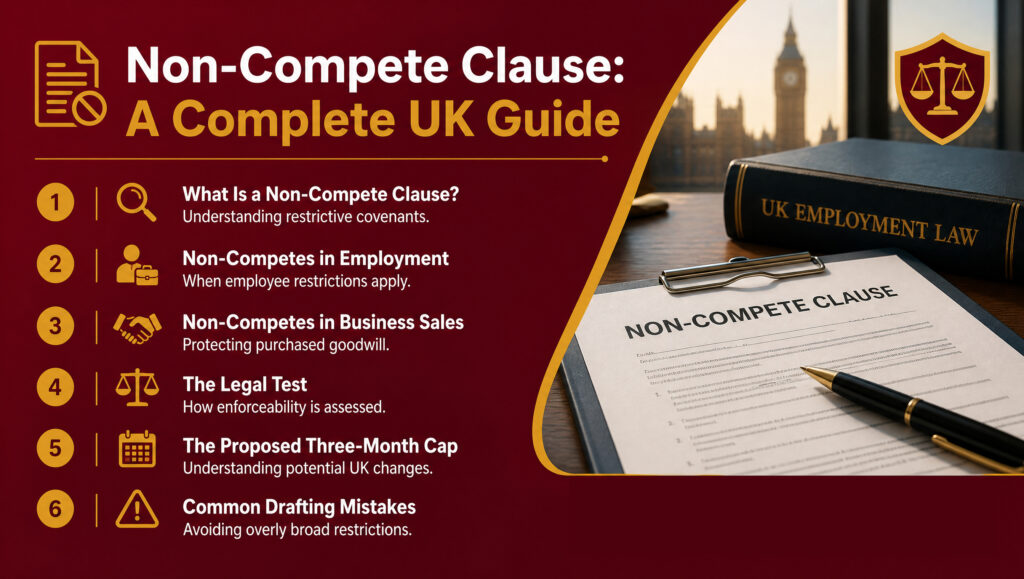
Non-Compete Clauses in Employment Contracts
What They Typically Restrict
Employment non-competes usually prevent a departing employee from joining a competing business or starting a competing venture for a specified period, typically between three and twelve months. They may also define a geographic area and the specific activities that are restricted.
They are most commonly used for senior employees, directors, and individuals with access to trade secrets, confidential commercial information, or key client relationships. A warehouse operative is unlikely to have a non-compete in their contract. A sales director almost certainly will.
Enforceability
Under English common law, non-compete clauses are treated as restraints of trade. The starting position, established in Nordenfelt v Maxim Nordenfelt Guns and Ammunition Co Ltd in 1894 and still the governing principle, is that restraints of trade are void unless the employer can demonstrate two things. First, that the restriction protects a legitimate business interest. Second, that it goes no further than is reasonably necessary to protect that interest.
Legitimate business interests include trade secrets, confidential information, and stable client or customer relationships. Protecting against ordinary competition is not a legitimate interest. A clause that simply prevents an employee from working in the same industry without any connection to confidential information or client relationships is unlikely to survive challenge.
Reasonableness is assessed at the date the contract was entered into, not at the date of enforcement. The duration, geographic scope, and breadth of restricted activities must all be proportionate. Courts have upheld non-competes of up to twelve months for senior employees in certain sectors. Anything longer faces a very high bar.
How to Challenge One
If you believe a non-compete clause is unreasonable, you can challenge it. The burden of proof is on the employer to demonstrate that the clause is enforceable. If they cannot, the clause is void.
Courts will not rewrite an unreasonable clause to make it enforceable. In some cases they may apply the blue pencil test, severing an offending part of the clause if it is grammatically and conceptually separable from the rest. But they will not substitute different words or narrower terms. If the clause as drafted is too wide, it fails. Other restrictive covenants in the same contract, such as non-solicitation or confidentiality clauses, may survive if they are drafted as independent provisions.
Non-Compete Clauses in Business Sales
Why They Are Treated Differently
Courts apply a more generous standard to non-compete clauses in a sale-of-business context than in employment. The rationale is straightforward. The seller has received payment for the goodwill of the business and has freely negotiated the restriction as part of a commercial transaction between parties with comparable bargaining power.
An employee accepting a job offer is in a weaker negotiating position. A business owner selling a company for a substantial sum is not. The courts reflect that difference in how they assess reasonableness. Restrictions that would be struck down in an employment contract may well be upheld in a share purchase agreement or asset purchase agreement.
Scope, Duration, and Geography
Non-compete periods of two to three years are common in UK business sales and are routinely upheld where the scope and geography are proportionate. The geographic area should reflect the actual market in which the business operates. The restricted activities should match the services the business provides.
A dental practice seller restricted from practising dentistry within five miles for three years is proportionate. An accountancy firm seller restricted from offering any financial services anywhere in the UK for five years is likely to fail. The restriction must protect the goodwill the buyer has paid for without preventing the seller from earning a living entirely.
The Legal Test
The two-part test from Nordenfelt applies across both employment and business sale contexts. Does the restriction protect a legitimate business interest. Does it go no further than is reasonably necessary to protect that interest.
In employment cases, the legitimate interests are narrowly defined: trade secrets, confidential information, and client relationships. In business sale cases, the legitimate interest is the goodwill the buyer has purchased, which is a broader concept and supports wider restrictions.
The test is applied objectively. What the parties intended is less important than what the clause actually says. A clause that reads as reasonable but is drafted in a way that captures activity far beyond the legitimate interest will not be saved by the fact that neither party expected it to be applied that broadly.
The Proposed Three-Month Cap
The UK government has consulted on capping non-compete clauses in employment contracts at a maximum of three months. As of mid-2026, this has not been enacted into legislation. The Employment Rights Act 2025 received Royal Assent but does not regulate non-compete clauses directly.
If the cap is introduced, it will apply only to non-competes in employment contracts and contracts of certain workers. It will not apply to business sale agreements, partnership agreements, or shareholder agreements. Non-solicitation and confidentiality clauses will not be affected. Employers and employees should monitor this development, but in the meantime the common law reasonableness test remains the operative framework.
Common Drafting Mistakes
Drafting a non-compete clause too broadly is the most frequent error. A restriction that covers an entire country when the business only operates regionally. A duration of two years in an employment contract for a mid-level employee. A definition of competitive activity so wide it prevents the individual from working in any related field.
The second mistake is failing to update the clause when the employee’s role changes. An individual who joined as a graduate and now runs a department should not still be operating under the same restrictive covenants. The clause should reflect the individual’s current access to confidential information and client relationships, not their position at the date of hiring.
The third is relying on the non-compete as the primary protection. Confidentiality agreements, garden leave provisions, proper information security, and structured handover processes are often more practical and more enforceable than a non-compete clause on its own.
How Blackmont Legal Helps
Non-compete clauses sit at the intersection of employment law and commercial transaction law. Whether you are drafting one for a business sale, negotiating one in a share purchase agreement, or challenging one that you believe is unreasonable, the enforceability analysis requires specialist advice.
At Blackmont Legal, we draft and negotiate non-compete clauses in business sale agreements, shareholder agreements, and employment contracts. We advise sellers on what they are agreeing to, buyers on what will hold, and employees and directors on whether a clause they have signed is enforceable. We also represent clients in disputes where a non-compete has been breached or is being challenged.
Frequently Asked Questions
What is a non-compete clause?
A contractual provision that prevents someone from working for a competitor, starting a competing business, or engaging in competitive activity for a defined period after leaving their role or selling their business.
Are non-compete clauses enforceable in the UK?
Only if they protect a legitimate business interest and go no further than is reasonably necessary. The burden of proof is on the party seeking to enforce the clause.
How long can a non-compete clause last?
In employment contracts, courts have upheld periods of up to twelve months for senior employees. In business sale agreements, two to three years is common and routinely upheld where the scope is proportionate.
Can I challenge a non-compete clause?
Yes. If the clause is too broad in duration, geography, or scope, it may be unenforceable. Courts will not rewrite an unreasonable clause. If it fails the reasonableness test, it is void.
Is the government capping non-competes at three months?
The government has consulted on this but as of mid-2026 it has not been enacted. The proposal would apply only to employment contracts, not business sale or shareholder agreements.
What is the difference between a non-compete and a non-solicitation clause?
A non-compete prevents working in a competing business entirely. A non-solicitation clause only prevents approaching specific clients or customers. Non-solicitation is narrower and generally easier to enforce.
Do I need a solicitor for a non-compete dispute?
Yes. Enforceability depends on the specific wording, the context, and the current case law. A specialist solicitor can assess whether the clause holds and advise on next steps.