
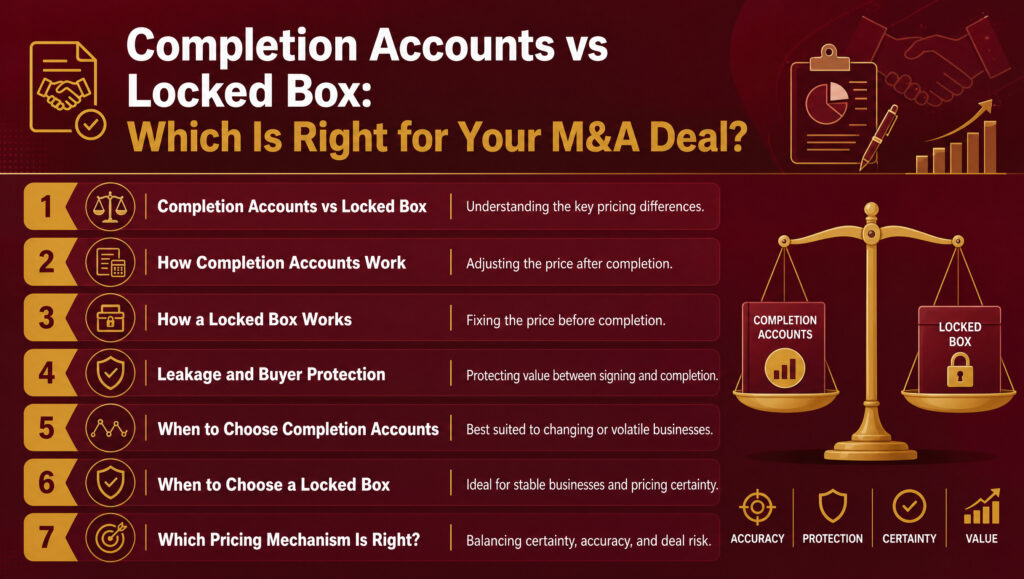
Every M&A transaction needs a mechanism for setting the final purchase price. In UK deals, there are two: completion accounts and locked box. One adjusts the price after the deal closes based on what the business actually looks like on completion day. The other fixes the price before signing and does not change it. Neither is inherently better. The right choice depends on the deal, the parties, and what matters more to each side: certainty or accuracy.
The Core Question: Certainty vs Accuracy
This is the simplest way to understand the difference.
Completion accounts prioritise accuracy. The buyer pays for the business as it actually stands on the day of completion, with the price adjusted afterwards once a set of accounts has been prepared and agreed. The final number is precise but takes time to settle and creates scope for disagreement.
Locked box prioritises certainty. The price is fixed before signing based on a set of historical accounts. There is no post-completion adjustment for normal trading movements. Both sides know the number from the moment the deal is signed. The trade-off is that the buyer takes on the risk that the business may have changed between the reference date and completion day.
Everything else follows from that distinction.
How Completion Accounts Work
Under a completion accounts mechanism, the buyer and seller agree a provisional purchase price at the outset. After completion, a set of accounts is prepared reflecting the target company’s actual financial position on the completion date. These accounts typically measure working capital, cash, debt, and in some cases specific balance sheet items agreed between the parties.
The provisional price is then adjusted up or down depending on how the actual figures compare to the estimates. If working capital is higher than expected, the buyer pays more. If net debt is higher, the buyer pays less. The process takes weeks or months after completion to finalise, and if the parties cannot agree, the SPA will provide for an independent accountant to determine the figures.
The mechanism is detailed and the drafting matters. What counts as cash, what counts as debt, what sits in working capital, what accounting policies apply, and what reference period is used for the target working capital figure are all negotiated provisions. Ambiguity in any of these definitions is where post-completion disputes start.
How Locked Box Works
Under a locked box mechanism, the purchase price is set by reference to a balance sheet prepared at a specific historical date, the locked box date. This is usually the date of the most recent audited or management accounts. The price is agreed before signing and is not adjusted after completion.
From the locked box date onwards, the economic risk and benefit of the business passes to the buyer, even though legal ownership does not transfer until completion. The seller continues to run the business in the interim period but cannot extract value from it. Any value that leaves the business between the locked box date and completion is called leakage, and the buyer is entitled to recover it pound for pound.
The locked box mechanism is cleaner and faster to execute. There is no post-completion accounting exercise. There is no adjustment dispute. The seller knows exactly what they are receiving, and the buyer knows exactly what they are paying. The trade-off is that the buyer must do more work before signing to satisfy themselves that the locked box accounts are accurate and that the leakage provisions are properly drafted.
Leakage Provisions
Leakage is the central protective mechanism in a locked box deal. It prevents the seller from extracting value from the business after the locked box date.
Leakage typically includes dividends, management charges, intercompany payments to the seller or its connected parties, bonuses or payments outside the ordinary course, and any transfer of assets at below market value. The SPA will contain a covenant from the seller that no leakage has occurred, backed by an indemnity requiring repayment if it has.
Permitted leakage is the exception. These are specific payments that the buyer has agreed the seller can make during the interim period, such as ordinary course salary payments, agreed bonuses, or pre-approved distributions. Permitted leakage is negotiated and listed in the SPA. Everything not listed is prohibited.
The leakage provisions need to be comprehensive and precisely drafted. A gap in the definition allows the seller to extract value that the buyer thought they were paying for. An overly broad restriction prevents the seller from running the business normally during the interim period.
When to Use Which
When Completion Accounts Make Sense
Completion accounts suit transactions where the business is volatile, seasonal, or going through a period of significant change. If the financial position of the business is likely to look materially different on completion day compared to any historical balance sheet, an adjustment mechanism gives the buyer confidence that they are paying for what they actually receive.
They also suit deals with a long gap between signing and completion, where regulatory approvals or third-party consents create an extended interim period. The longer the gap, the greater the risk that historical accounts no longer reflect reality.
Completion accounts are the traditional mechanism and remain the default in many UK sectors. They are more familiar to generalist advisers and lenders, which can simplify the transaction process for smaller deals.
When Locked Box Makes Sense
Locked box suits transactions where both parties want a clean, fast completion with no post-deal accounting exercise. It is the dominant mechanism in private equity-led transactions because PE sellers want certainty of proceeds and a clean exit without months of post-completion negotiation.
It also works well where the business is stable, the financial position is predictable, and the locked box accounts are recent and reliable. The closer the locked box date is to the expected completion date, the lower the risk for the buyer.
Locked box is increasingly common in UK mid-market deals because it reduces post-completion friction and removes one of the most common sources of M&A disputes. The cost is that the buyer must invest more in pre-signing due diligence to validate the locked box accounts and ensure the leakage provisions are watertight.
Common Mistakes
Three mistakes recur across both mechanisms.
The first is choosing the mechanism based on market convention rather than the specific deal. A locked box mechanism applied to a volatile business with a stale balance sheet creates buyer risk that could have been avoided. Completion accounts applied to a clean, stable business with a willing PE seller adds unnecessary post-deal complexity.
The second is poor drafting of the adjustment or leakage provisions. In completion accounts deals, disputes over what constitutes working capital versus debt are the single most common source of post-completion disagreement. In locked box deals, gaps in the leakage definition allow value extraction the buyer did not anticipate.
The third is leaving the mechanism choice to the end of the negotiation. The pricing mechanism should be agreed at heads of terms stage, not during document negotiation. Changing it late in the process requires a fundamental restructuring of the deal economics.
How Blackmont Legal Helps
The pricing mechanism is one of the most consequential structural decisions in any M&A transaction. The drafting of the completion accounts provisions or the leakage covenants directly determines whether the buyer pays the right price and whether the seller receives the agreed proceeds without months of post-deal dispute.
At Blackmont Legal, we advise buyers and sellers on both mechanisms. We draft the adjustment provisions in completion accounts deals and the leakage covenants in locked box deals, negotiate the definitions that drive the final price, and manage the dispute resolution process where the parties cannot agree. We make sure the mechanism fits the deal, not the other way around.
Frequently Asked Questions
What is the difference between completion accounts and locked box?
Completion accounts adjust the purchase price after the deal closes based on the business’s actual financial position at completion. Locked box fixes the price before signing based on historical accounts with no post-completion adjustment.
Which is more common in UK M&A?
Locked box has become increasingly dominant, particularly in private equity-led transactions. Completion accounts remain common in SME deals and sectors where financial volatility makes a fixed price impractical.
What is leakage in a locked box deal?
Any value extracted from the business between the locked box date and completion. This includes dividends, management charges, intercompany payments, and asset transfers. The seller indemnifies the buyer for any leakage that occurs.
What is permitted leakage?
Specific payments the buyer has agreed the seller can make during the interim period, such as ordinary course salaries or pre-approved bonuses. These are listed in the SPA.
What causes disputes in completion accounts deals?
Disagreements over what constitutes working capital, cash, or debt under the SPA definitions. Ambiguous drafting is the most common cause.
When should the pricing mechanism be agreed?
At heads of terms stage. Changing the mechanism during document negotiation requires a fundamental restructuring of the deal economics and should be avoided.