
Software licensing is a core legal issue for any organisation that develops, supplies, or relies on software in the UK. Poor licensing decisions expose businesses to legal, financial, and reputational risk. This article sets out the key legal considerations that software licensors and licensees must understand to remain compliant and protect their commercial and intellectual property interests.
What a Software Licence Means
A software licence sets out the precise terms that govern how software may be used, modified, distributed, or reproduced. It defines ownership of the underlying intellectual property and the scope of the licence, including permitted users, permitted uses, restrictions on activity, payment terms, and the rights and obligations of each party.
When these terms are poorly drafted or unclear, ambiguity and dispute are almost inevitable. For example, where a licence does not expressly prohibit sublicensing, a licensee may lawfully sublicense the software without the licensor’s consent, undermining the IP owner’s control and commercial position.
Securing Intellectual Property Rights
In the UK, copyright is the primary means of protecting software. Depending on the nature of the product, additional protection may also arise through trade secrets, trademarks, or patents, particularly where the software incorporates a novel technical invention or functions as a key brand asset.
For licensors of proprietary software, it is essential that licence agreements impose strict usage restrictions, such as prohibitions on decompiling, reverse engineering, or redistribution, and include clear confidentiality obligations. Without these protections, licensees may dilute, misuse, or erode the value of the software.
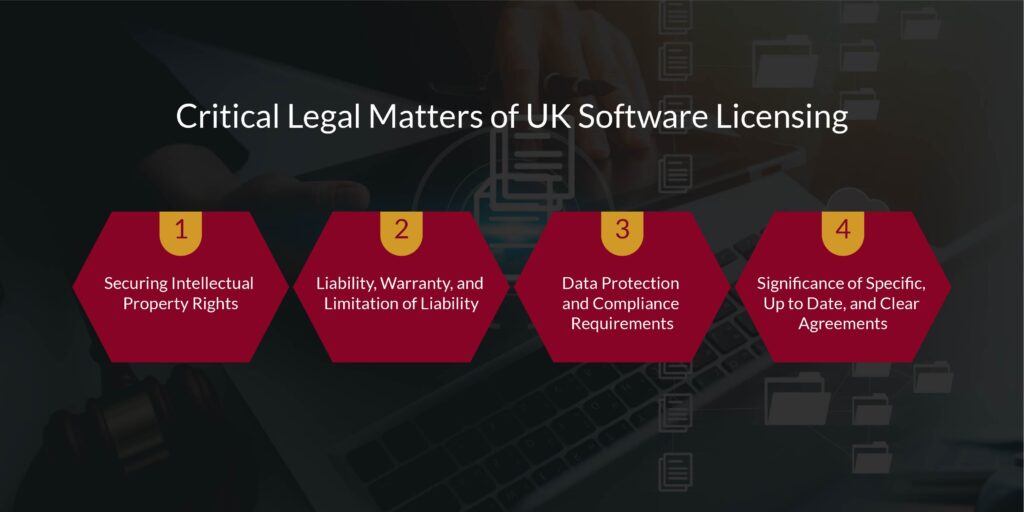
Liability, Warranty, and Limitation of Liability
Software licensing agreements carry inherent legal and commercial risk. If software fails or causes loss or damage to a customer, such as downtime, data loss, or a security breach, the licensor may face significant claims. Without a carefully drafted limitation of liability clause, exposure can far exceed the licence fees received, which may be commercially unsustainable, particularly for smaller software providers.
Licensors must therefore approach warranties, disclaimers, and liability caps with care. These provisions must be properly negotiated and drafted to ensure they are enforceable under UK law, taking into account statutory controls and common law principles governing contractual fairness and reasonableness.
Data Protection and Compliance Requirements
Many software products process personal, financial, or otherwise sensitive data. Where software collects, stores, or processes personal data, UK businesses must comply with the UK data protection regime.
Licensing arrangements should clearly address data protection obligations, including security standards, data storage and transfer rules, and the use of data processing agreements. This is particularly critical where software is supplied to public sector bodies or organisations handling sensitive or regulated data.
Significance of Specific, Up to Date, and Clear Agreements
Generic or template licence agreements often create unnecessary legal risk, especially where they are designed for different jurisdictions or business models. They may fail to clearly define licence scope, misalign with payment structures, or overlook essential obligations relating to data protection, confidentiality, sublicensing, or modification.
Given the pace of change in software delivery models, including cloud services, SaaS platforms, open source dependencies, remote working, and cross border use, licensing agreements must be reviewed and updated regularly. Keeping agreements current reduces the risk that outdated provisions leave businesses exposed to avoidable legal or regulatory issues.
Why Legal Advice Matters
Software licensing sits at the intersection of intellectual property law, contract law, data protection law, and, in some cases, sector specific regulation. In complex or high risk scenarios, reliance on standard templates is rarely sufficient. Specialist legal advice from solicitors experienced in software and IT law is often essential.
A well structured licence agreement protects commercial value, limits liability exposure, supports regulatory compliance, and reduces the likelihood of disputes or enforcement action.
Conclusion
UK software licensing is not a box ticking exercise. It is a critical legal safeguard. Whether you are licensing software as a developer or relying on software as a business user, robust licensing arrangements are essential for clarity, legal protection, compliance with data laws, controlled liability, and long term stability.
As technology and regulation continue to evolve, businesses should regularly review their licensing frameworks and seek advice from solicitors with expertise in software and technology law to ensure they remain protected.