
Most commercial contracts run smoothly until something unexpected makes performance impossible. A pandemic shuts down supply chains. A war disrupts international logistics. A natural disaster destroys a supplier’s facility. Without a force majeure clause, a business facing any of these events is still legally bound to perform, or face breach of contract. This article explains what the clause does, what goes into it, and how it operates under English law.
What Is a Force Majeure Clause?
A force majeure clause is a contractual provision that excuses one or both parties from performing their obligations when an extraordinary event beyond their control makes performance impossible, impractical, or significantly delayed.
The term comes from French and translates literally as “superior force.” In English contract law, force majeure has no standalone legal status. It exists only where it is expressly written into a contract. If the clause is absent, the obligation to perform remains, regardless of the circumstances that have made performance impossible. That distinction matters enormously for any business entering a commercial agreement.
What a Force Majeure Clause Includes
Covered Events
The clause must define which events qualify as force majeure. Courts interpret these definitions strictly and will not extend the clause beyond what is written. Standard commercial clauses typically list acts of God, natural disasters, floods, earthquakes, fire, war, terrorism, government action, pandemics, strikes, and failure of third-party utilities or infrastructure.
The list needs to reflect the specific risks of the contract and the industry. A logistics business faces different exposure than a software company. A clause drafted for one type of commercial relationship may leave significant gaps when applied to another.
Notice Requirements
Invoking force majeure is not automatic. The affected party must notify the other party within a defined timeframe, typically as soon as reasonably practicable after the event occurs. The notice must identify the nature of the event, explain how it affects performance, and set out the expected duration of the impact.
Failure to give proper notice can invalidate the force majeure claim entirely, even where the underlying event clearly qualifies. This is one of the most common reasons force majeure defences fail in UK commercial disputes.
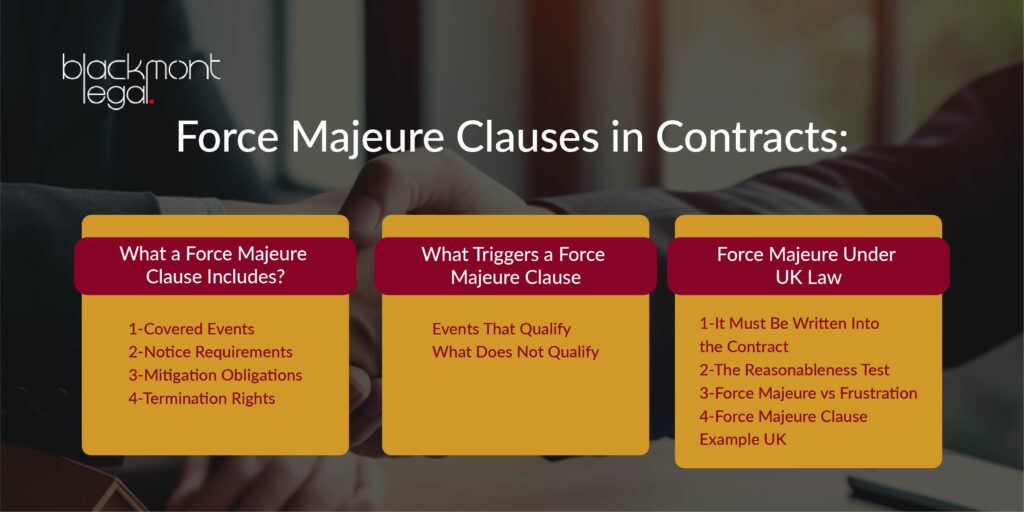
Mitigation Obligations
The clause will almost always require the affected party to take reasonable steps to mitigate the impact of the force majeure event and to resume performance as soon as it becomes possible. A business cannot simply stop performing and rely on the clause indefinitely without demonstrating active efforts to manage the situation and restore its obligations.
Courts take mitigation seriously. A party that could have minimised the disruption but chose not to will struggle to maintain a force majeure defence under English law.
Termination Rights
Where the force majeure event continues beyond a specified period, typically 30, 60, or 90 days depending on the contract, either party will usually have the right to terminate the agreement by written notice. A well-drafted clause will set out what happens on termination: how outstanding payments are handled, whether any obligations survive, and how the parties wind down their relationship.
What Triggers a Force Majeure Clause
Events That Qualify
To trigger the clause, three conditions generally need to be met. The event must fall within the list of qualifying events defined in the contract. It must be beyond the reasonable control of the affected party. And it must actually prevent or delay performance, not merely make it more expensive or less commercially attractive.
Events that UK courts have recognised as capable of triggering force majeure include government-imposed lockdowns during Covid-19, acts of war affecting international trade routes, and extreme weather events causing physical impossibility of performance.
What Does Not Qualify
A contract becoming unprofitable does not trigger force majeure. A change in market conditions, rising costs, supply shortages caused by poor planning, or commercial inconvenience will not qualify. English courts apply the clause narrowly and will not extend it to events the affected party could reasonably have anticipated or planned for at the time of contracting.
A party that accepted a contract knowing a particular risk existed cannot later claim that risk as a force majeure event. The clause protects against the genuinely unforeseeable, not against bad commercial decisions.
Force Majeure Under UK Law
It Must Be Written Into the Contract
Under English contract law, force majeure is not an implied term. It cannot be read into an agreement by a court after the fact. If the contract does not include an express force majeure provision, the clause does not exist, and the parties must rely on other legal doctrines to seek relief.
This is a fundamental point that distinguishes English law from many civil law jurisdictions, where force majeure is a statutory concept that applies regardless of whether the contract mentions it.
The Reasonableness Test
In business-to-business contracts governed by written standard terms, force majeure clauses must satisfy the reasonableness test under the Unfair Contract Terms Act 1977. A clause that attempts to classify events within a party’s control as force majeure events, or that is drafted so broadly as to excuse performance in circumstances that are clearly foreseeable, risks being deemed unreasonable and therefore unenforceable.
In negotiated contracts between commercial parties, the position is more flexible. The parties are free to define force majeure events as they see fit, and the courts will generally give effect to what was agreed.
Force Majeure vs Frustration
Where no force majeure clause exists, a party may attempt to rely on the common law doctrine of frustration under the Law Reform (Frustrated Contracts) Act 1943. Frustration applies where performance has become legally or physically impossible through no fault of either party, and the courts have consistently held that the threshold is high.
Commercial impracticality, increased cost, or delay alone will not satisfy the frustration doctrine. Where force majeure and frustration overlap, the express contractual clause takes precedence. Frustration is a remedy of last resort, not a substitute for a well-drafted force majeure provision.
Force Majeure Clause Example UK
A standard force majeure clause under English law might read as follows:
“Neither party shall be in breach of this Agreement or liable for any failure or delay in performing its obligations under it if such failure or delay results from events, circumstances, or causes beyond its reasonable control, including but not limited to acts of God, natural disasters, war, terrorism, pandemic, or government action. The affected party must notify the other party in writing as soon as reasonably practicable. If the force majeure event continues for more than 60 days, either party may terminate this Agreement by written notice.”
This is a starting point, not a template. Every commercial contract requires a clause drafted to its specific context, risks, and industry.
How Blackmont Legal Helps
Force majeure clauses look simple. In practice, a poorly drafted clause can leave a business entirely unprotected when an event occurs, or expose it to a claim it cannot defend.
At Blackmont Legal, we draft and review force majeure provisions as part of our commercial contract work. We identify the gaps in existing clauses, advise on whether a force majeure event has been triggered, and represent businesses in disputes where force majeure is being claimed or challenged. Our contract work covers all sectors, including technology, media, distribution, and supply chain agreements.
Conclusion
A force majeure clause is not a standard boilerplate addition. It is a risk allocation tool that determines what happens to your business when the unexpected occurs. Under English law, if it is not in the contract, it does not exist. If it is poorly drafted, it may not hold. Getting it right from the outset is significantly cheaper than disputing it after an event has already disrupted your commercial relationships.
Frequently Asked Questions
Are force majeure clauses enforceable in the UK? Yes, where they are expressly included in the contract and drafted clearly. In standard terms of business, they must also satisfy the reasonableness test under the Unfair Contract Terms Act 1977.
Does force majeure apply automatically under UK law?
No. Unlike many civil law jurisdictions, English law does not imply force majeure into contracts. It must be expressly written into the agreement to have any effect.
What should a force majeure clause include?
A list of qualifying events, notice requirements, mitigation obligations, and termination rights if the event continues beyond a specified period.