
A management buyout is one of the cleanest routes to business succession. The buyer already knows the business, the staff, the clients, and the risks. The seller gets an exit without handing the company to a competitor or a stranger. On paper, it should be straightforward. In practice, MBOs are complex transactions involving layered financing, detailed legal documentation, and a negotiation dynamic that is unlike any other deal because the buyer and seller have to keep working together until the day it completes.
What Is a Management Buyout
A management buyout is a transaction in which a company’s existing management team purchases all or a controlling share of the business they run. The seller is typically the founder, the current owner, or a parent company looking to divest a subsidiary.
MBOs are distinct from management buy-ins, where an external management team acquires a business they have no existing involvement with. They are also distinct from employee ownership trusts, where the business is transferred to a trust for the benefit of all employees. In an MBO, the management team becomes the owner, takes on the financial risk of the acquisition, and assumes full responsibility for the business from completion.
How Does a Management Buyout Work
Feasibility and Initial Approach
The process starts with the management team assessing whether a buyout is realistic. That means understanding the approximate value of the business, whether the owner is willing to sell to the management team, and whether the deal can be financed.
The initial approach to the owner is sensitive. The management team is signalling that they want to buy the business they are employed to run. If the approach is handled badly, it can damage the working relationship before any deal is discussed. Most advisers recommend engaging a corporate finance adviser before the approach is made, so the conversation is structured and commercially grounded from the start.
Valuation
The management team and the owner will rarely agree on price without independent input. A corporate finance adviser or specialist valuer will assess the business using an appropriate methodology, typically an EBITDA multiple for trading businesses or a revenue multiple for professional practices.
The valuation needs to reflect what the business can sustain under new ownership with acquisition debt on the balance sheet. A price that is commercially fair to the seller but financially unsustainable for the buyer under the proposed financing structure will collapse the deal during the funding stage.
Financing the Deal
Management teams rarely have the capital to fund an MBO outright. Most UK management buyouts are financed through a combination of sources: management equity, senior debt from a bank or specialist lender, vendor loan notes from the seller, and in larger transactions, private equity or mezzanine finance.
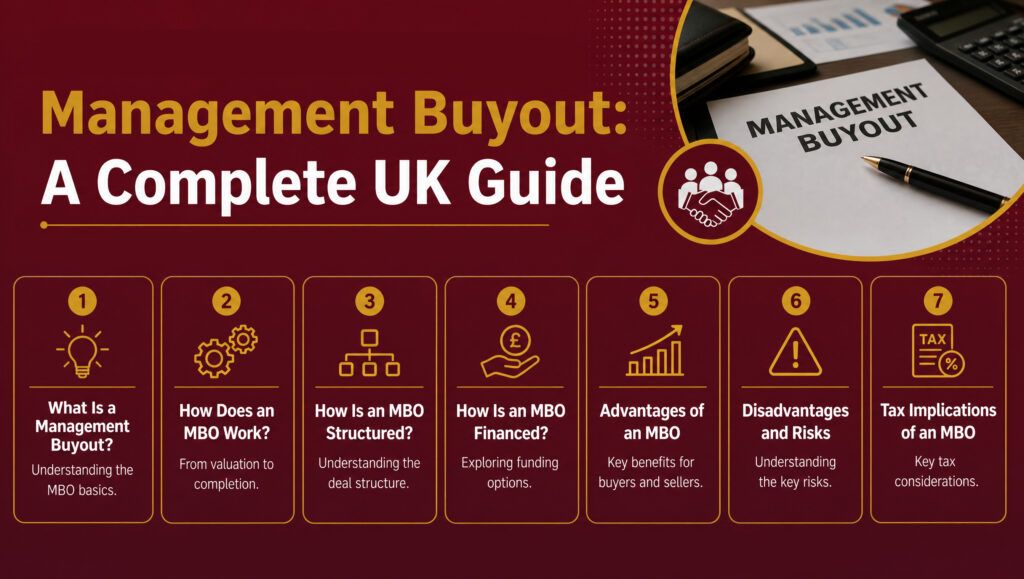
The management team’s personal equity contribution matters. Lenders and investors treat it as a commitment signal. A team that has invested meaningful personal capital is demonstrably aligned with the success of the business in a way that a team with no financial exposure is not. The financing structure determines who controls the business post-completion, how returns are shared, and what happens if the business underperforms. Getting it wrong is very difficult to reverse.
Due Diligence
Even though the management team knows the business operationally, legal and financial due diligence is still required. The lenders and any private equity investors will insist on it, and the management team’s solicitor will conduct a full legal review to identify risks that the team may not have visibility of from their operational position.
Due diligence in an MBO covers the same ground as any acquisition: contracts, employment obligations, IP ownership, regulatory standing, litigation history, and financial performance. Issues identified during due diligence either get resolved before completion, get reflected in the price, or trigger a renegotiation of the deal terms.
Completion
Completion involves the signing of the share purchase agreement, the release of funds, the transfer of shares, and the formal change of ownership. The management team moves from being employees to being owners. Any vendor loan notes begin their repayment terms. Any private equity shareholder agreements take effect.
Post-completion, the management team is responsible for servicing the acquisition debt, running the business, and delivering the performance that the financing structure was built on. The first 12 months after completion are typically the most demanding period for a newly formed management ownership team.
MBO Structure
Most UK management buyouts use a newco structure. A new holding company is formed by the management team. The holding company raises the finance and acquires the shares of the target business. The target company becomes a subsidiary of the new holding company.
This structure separates the acquisition debt from the operating business and creates a clean vehicle for the equity split between management and any external investors. Where private equity is involved, the holding company’s shareholder agreement governs the relationship between the management team and the PE fund, including board composition, reserved matters, drag-along and tag-along rights, and the terms of any future exit.
The structure is largely irreversible once in place. Changing it post-completion requires a complex reorganisation and potentially triggers adverse tax consequences. Getting it right before completion is essential.
Advantages and Disadvantages
Advantages
The management team already knows the business. They understand the clients, the staff, the operations, and the risks. That familiarity reduces deal risk for lenders and investors. It also reduces disruption for the business during the transition period.
For the seller, an MBO provides an exit without the uncertainty of an open market sale. There is no risk of confidential information being shared with competitors during a marketing process. The seller can also retain some involvement through vendor loan notes or a consultancy arrangement, providing continued income while the management team takes over.
For the business itself, an MBO preserves continuity. Staff, clients, and suppliers deal with the same people before and after the deal. That stability is commercially valuable and often supports a smoother transition than an external sale.
Disadvantages
The management team carries significant personal financial risk. Most lenders require personal guarantees and meaningful equity contributions. If the business underperforms, the management team stands to lose both their investment and their employment.
Financing can be difficult to secure. Lenders assess the management team’s ability to service acquisition debt from the business’s cash flow. If the valuation is too high or the financing structure too aggressive, the deal will not get funded.
The negotiation dynamic is also unusual. The management team is negotiating with someone who is currently their employer. That power imbalance can make price negotiations, warranty discussions, and heads of terms conversations more difficult than in an arm’s length transaction.
Tax Implications
Tax planning should happen before heads of terms are agreed, not after. The structure of the deal, the treatment of vendor loan notes, and the eligibility for Business Asset Disposal Relief under the Taxation of Chargeable Gains Act 1992 all depend on decisions made early in the process.
For the seller, Business Asset Disposal Relief can reduce capital gains tax on qualifying gains. Whether the relief applies depends on the seller’s shareholding, their involvement in the business, and the structure of the transaction. For the management team, the way equity is acquired and incentivised has direct tax consequences. Share option schemes, growth shares, and sweet equity arrangements each carry different tax treatment and need to be structured with specialist advice.
How Blackmont Legal Helps
A management buyout involves layered legal complexity: share purchase agreements, shareholder agreements, financing documents, warranty negotiations, and post-completion obligations that bind the management team for years after the deal closes.
At Blackmont Legal, we advise management teams and sellers on the legal side of MBOs. We structure the transaction, draft and negotiate the share purchase agreement, advise on the shareholder agreement with any external investors, and manage the due diligence process. We coordinate with corporate finance advisers and tax specialists so the legal structure and the financing structure work together from the start.
Frequently Asked Questions
What is a management buyout?
A transaction in which a company’s existing management team purchases the business they run, typically financed through a combination of personal equity, bank debt, vendor loan notes, and in some cases private equity.
How long does an MBO take?
A typical UK management buyout takes four to six months from initial approach to completion. Deals involving private equity or complex financing structures can take longer.
How is an MBO financed?
Through a combination of management equity, senior debt, vendor loan notes, and where applicable mezzanine finance or private equity. The management team is expected to contribute meaningful personal capital.
What is the difference between an MBO and an MBI?
In an MBO, the existing management team buys the business. In an MBI, an external management team acquires a business they have no prior involvement with.
Do I need a solicitor for a management buyout?
Yes. The share purchase agreement, shareholder agreements, financing documents, and warranty negotiations all carry significant legal risk. A solicitor with MBO experience will identify issues that a generalist will miss.
What are the tax implications of a management buyout? The seller may qualify for Business Asset Disposal Relief under the Taxation of Chargeable Gains Act 1992. The management team’s equity structure has direct tax consequences depending on how shares are acquired and incentivised. Tax advice should be taken before heads of terms are agreed.